
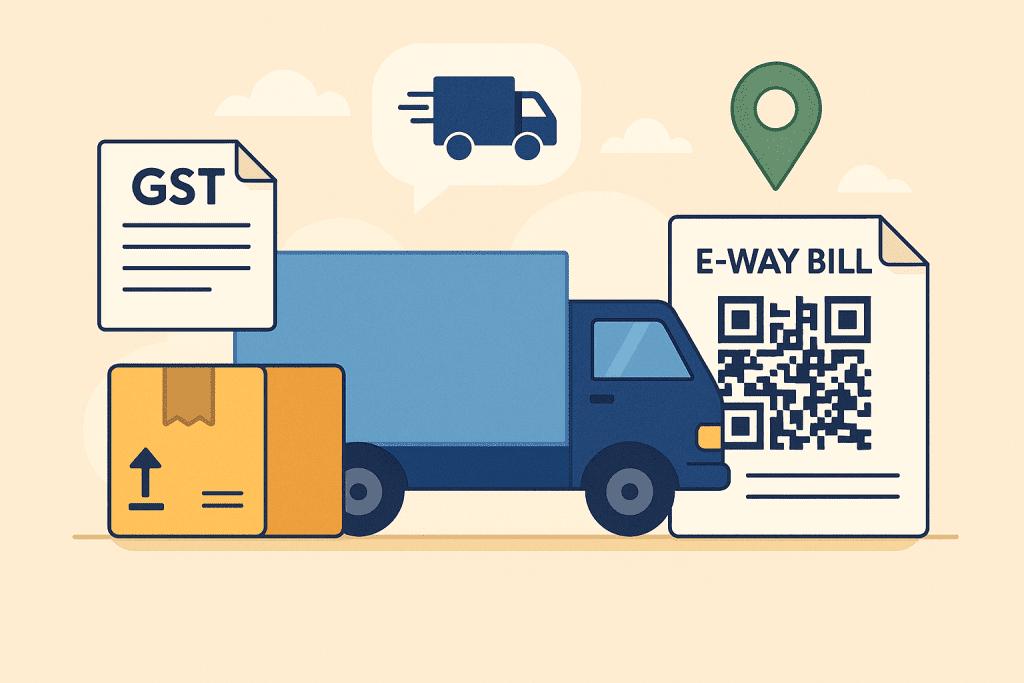
What is an E-Way Bill?
An E-Way Bill is an electronic permit generated on the GST portal for movement of goods worth more than the prescribed amount. It is legally required when goods are transported either within the state or between states.
In simple words, if goods are being transported, an online permit is needed which contains details of the transporter, goods, vehicle and invoice.
Businesses already using tools like the Invoice Generator can seamlessly prepare GST-compliant invoices before generating an E-Way Bill.
Why E-Way Bill Exists
The purpose of the E-Way Bill system is to:
- prevent tax evasion
- track movement of GST goods
- verify actual shipment
- reduce offline documentation
- maintain supply-chain transparency
Applicability of E-Way Bill
E-Way Bill is mandatory when:
- movement of goods value is ₹50,000 or more
- inter-state supply of goods
- intra-state supply beyond permitted distance
- purchase from unregistered person
- e-commerce shipments
Both registered and unregistered suppliers may be required to generate it in certain conditions.
E-Way Bill Limit
E-Way Bill is required when the invoice value exceeds ₹50,000.
However, some states allow generating even for smaller values voluntarily and certain states have additional conditions.
You can calculate value including GST and freight using the online GST Calculator already available on your website.
Who Must Generate E-Way Bill
- Supplier
- Recipient
- Transporter
- E-commerce operator (in specific cases)
Whenever goods are physically moved, someone involved must generate the E-Way Bill depending on who is responsible for movement.
Situations Where E-Way Bill Is Mandatory
- GST registered supplier
- Unregistered supplier
- Job work
- Import or export supply
- Transfer between branches
- E-commerce supply
Documents Required
To generate E-Way Bill, you need:
- GST invoice
- Transporter ID
- Vehicle number
- Delivery challan (in some cases)
That’s why invoice creation and GST filing tools become important for businesses.
Validity of E-Way Bill
| Distance | Validity |
|---|---|
| Up to 200 km | 1 day |
| Every additional 200 km | +1 day |
Validity starts from the time E-Way Bill is generated.
E-Way Bill for Return Goods
If goods are returned, a new E-Way Bill must also be generated by the returning party.
When E-Way Bill Is Not Required
No E-Way Bill required for:
- Non-motorized vehicle transport
- Transport within 10 km (in some states)
- Customs-bonded warehouse movement
- Government goods
- Transport of exempt goods
- Handicraft goods (in some cases)
Penalty for Not Generating E-Way Bill
If goods are moved without E-Way Bill, penalty includes:
- ₹10,000 minimum
or - amount equal to tax evaded
Goods may also be seized until penalty is paid.
This is why many businesses take monthly GST compliance services including E-Way Bill filing and GST return filing.
Generation Process (Step-by-Step)
1️⃣ Login to ewaybillgst.gov.in
2️⃣ Click Generate New
3️⃣ Enter supplier details
4️⃣ Enter invoice details
5️⃣ Add product & HSN
6️⃣ Enter vehicle number
7️⃣ Generate E-Way Bill
One unique EBN number will be generated for the shipment.
Applicability Timeline
E-Way Bill system started nationwide from 1st April 2018, and rules continue to apply for all GST registered businesses above the ₹50,000 movement threshold.
Practical Example
If a business purchases material worth ₹90,000 from another state, it must generate an E-Way Bill before loading the goods, even if payment has not yet been made.
Key Benefits
- Real-time shipment tracking
- Reduced manual paperwork
- Seamless GST compliance
- Prevents tax leakage
- Automates return filing data
Frequently Asked Questions
Is E-Way Bill compulsory for ₹40,000?
No — required above ₹50,000.
Can we generate E-Way Bill without GST?
Yes, in specific unregistered supply cases.
Is E-Way Bill required for B2C?
Yes, if shipment value exceeds ₹50,000.
Conclusion
The E-Way Bill system remains one of the most important transport compliance requirements under GST, helping prevent invoice fraud and enabling smooth interstate movement of goods. Businesses must ensure every shipment above limit includes the digitally generated permit, or they may face penalties and detention of goods.
Many businesses use ModernMunshiji for complete GST compliance — including invoice creation, GST return filing, monthly GST support and transport documentation management — making compliance hassle-free and fully digital.