
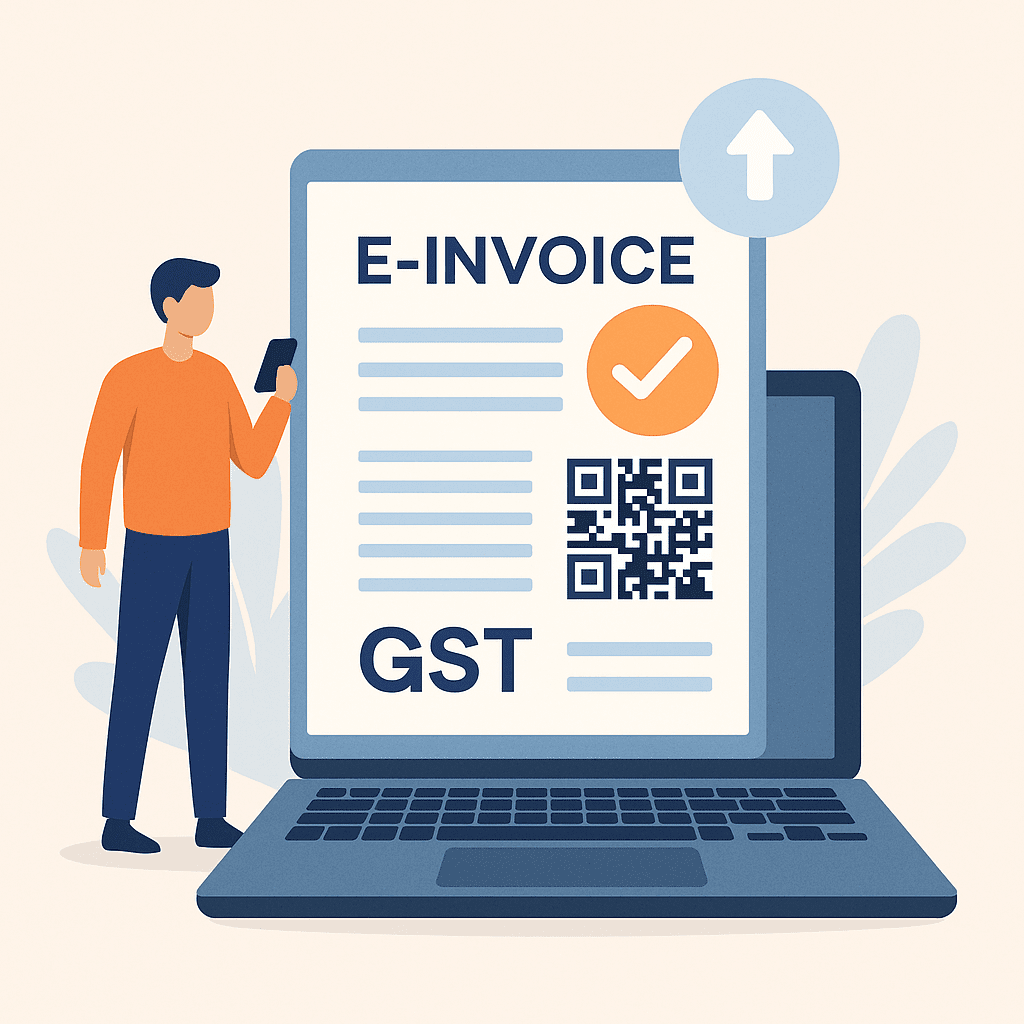
What is e-Invoicing under GST?
e-Invoicing under GST is the system where B2B invoices must be electronically authenticated on the government Invoice Registration Portal (IRP). After uploading invoice details, IRP generates:
- IRN (Invoice Reference Number)
- QR Code
Only invoices with a valid IRN are considered legally valid for Input Tax Credit under GST.
Businesses can easily generate GST-compliant invoices using online software, and ModernMunshiji already provides an easy Invoice Generator in the tools section.
Why e-Invoicing Was Introduced
The main objective of e-invoicing is to create a standard invoice format and reduce:
- fake invoices
- invoice duplication
- mismatched GST returns
- input tax credit fraud
- manual reconciliation
This brings transparency and enables real-time tracking of invoices in GST ecosystems.
How e-Invoicing Works (Simple Explanation)
- Business creates invoice in its accounting system
- Invoice is uploaded to IRP
- IRP validates & generates IRN & QR code
- Invoice becomes legally valid
- Invoice auto-populates in GSTR returns
The entire process is automatic and integrated with GST return filing, making compliance simpler.
If you want to quickly estimate GST amount while generating bills or invoices, your website already has a GST Calculator that businesses can use instantly.
Who Must Generate e-Invoices? (Applicability Rules 2025)
e-invoicing is applicable based on aggregate turnover in any previous financial year.
Current limit (as of 2025)
e-Invoicing is mandatory for businesses with turnover ₹5 crore and above in any FY.
This includes:
- Manufacturers
- Traders
- Service providers
- Exporters
Even if turnover fell later, once threshold is crossed anytime, the rule remains applicable.
Who is Exempt from e-Invoicing?
Exempt categories include:
- Banks & financial institutions
- NBFCs
- Insurance companies
- SEZ units
- GTA services
- Passenger transport services
e-Invoicing Limit Timeline
| Effective From | Turnover criteria |
|---|---|
| Oct 2020 | ₹500 crore |
| Jan 2021 | ₹100 crore |
| Apr 2021 | ₹50 crore |
| Oct 2022 | ₹10 crore |
| Aug 2023 | ₹5 crore |
(Subject to future notifications by CBIC)
Documents Covered Under e-Invoicing
- B2B invoices
- Export invoices
- B2G invoices
- Credit notes
- Debit notes
NOT applicable for B2C invoices (normal consumer invoices).
What Happens if e-Invoice Is Not Generated?
Invoice without IRN is considered invalid, resulting in:
- penalty
- loss of ITC
- notices
- rejection of invoice
In a worst case scenario, the invoice may be treated as without GST, leading to compliance penalties.
Businesses must ensure timely invoice reporting or use automated tools like ModernMunshiji’s invoicing software.
Benefits of e-Invoicing
- No duplicate invoices
- Faster ITC reflection
- Auto-generated GSTR data
- Reduces manual entry
- Fraud prevention
- One standardized invoice format
- Boosts compliance
Practical Example
A business generates invoice → uploads to IRP → receives IRN → prints invoice with QR code → claims ITC without delay.
Without IRN → invoice invalid → GST credit blocked.
Implementation Date of e-Invoicing
e-Invoicing began on:
1st October 2020
and gradually implemented in stages based on turnover limits.
Should Small Businesses Adopt e-Invoicing Early?
Even below the limit, voluntary adoption helps businesses:
- integrate systems early
- prepare for future mandatory rules
- automate accounting
- avoid future penalties
Most small businesses already use the online Quotation Maker and GST invoice tools provided on your platform.
Frequently Asked Questions
Is e-invoice standard format mandatory?
Yes, only standard schema accepted by IRP.
Is QR code compulsory?
Yes, invoices without QR code are invalid.
Can we generate e-invoice manually?
No — must be generated online from IRP.
Is e-invoice required for B2C?
No, only B2B and exports.
Conclusion
e-Invoicing under GST is now a compulsory compliance requirement for most medium-to-large businesses, and soon smaller businesses will also be included under the threshold. The best approach is to implement invoicing software early and stay ahead of compliance deadlines.
ModernMunshiji already offers a complete GST compliance suite—from GST invoice generation to GST filing—so businesses can comply without worrying about IRN, QR code, or return mismatches.